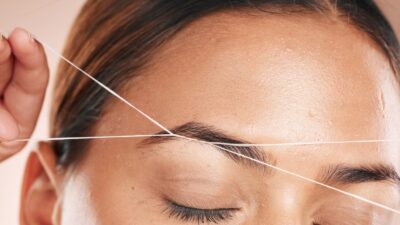


They can remove facial hair, but convenience and professional threading results are not necessarily the same thing.
As the founder of a brow and threading studio in Richmond, VA, and someone who has worked with threading for many years, I find it interesting when an old hair-removal idea suddenly finds a new audience.
One example is the manual facial threading tool that has recently become popular on Instagram and other social platforms. It looks simple: a small handheld device holds twisted thread and, as you move it across the skin, the thread catches and removes hair.
To someone who regularly pays for facial threading, it can look like an obvious solution.
But these tools aren’t really new. Variations have existed for years. So rather than dismissing them because they are trending—or recommending them because they look convenient—I think it is more useful to understand what they can and cannot do.
Does the viral threading tool actually work?
Yes, it can remove hair.
The basic principle isn’t very different from traditional threading. Twisted thread traps hairs and pulls them from the follicle.
So it would be unfair to say the tool does nothing.
The bigger question is whether it provides the control, precision and consistency you expect from professional threading.
For general facial hair removal, some people may find these devices useful. For detailed brow shaping or areas where hair grows in multiple directions, the experience can be quite different.
Is it better than tweezing or shaving?
It depends on what you want.
Shaving cuts hair at or near the skin’s surface. Tweezing removes individual hairs from the root. Threading can capture multiple hairs and remove them from the root.
A threading device therefore occupies an interesting middle ground for someone who wants an at-home alternative.
But each method has a different purpose.
If you simply want to remove visible facial hair conveniently, an at-home tool may be sufficient. If you want deliberate brow shaping or controlled removal around sensitive facial areas, precision becomes much more important.
Does it work well for the upper lip and chin?
It can—but control matters.
The upper lip and chin can contain hairs of different lengths, thicknesses and growth directions.
A threading tool may successfully pick up some of these hairs, but getting consistently clean removal can require repeated passes.
Traditional hand threading gives an experienced practitioner considerable control over the tension, angle and movement of the thread. That allows us to adapt as we move across different areas of the face.
A fixed handheld device may not provide the same degree of flexibility.
What about cheeks and facial hair?
This may be where it feels most practical.
For broader areas such as the cheeks or sides of the face, someone who isn’t looking for detailed shaping may find a threading tool convenient.
But technique still matters.
Repeatedly moving any hair-removal device over the same area can irritate the skin. More passes do not necessarily mean a better result.
The goal should always be effective removal with minimal unnecessary manipulation of the skin.
Can it shape eyebrows properly?
Hair removal and brow shaping are different skills.
This is probably the biggest distinction I would make as a brow professional.
Removing unwanted hairs around an eyebrow is one thing.
Designing the eyebrow is another.
Professional brow threading involves decisions about where hair should remain—not simply which hairs can be removed. We consider the natural brow, facial proportions, existing density, symmetry and the client’s preferred shape before progressively refining it.
A threading tool can remove hair, but the tool itself cannot make those decisions.
This is also why tweezers can remove eyebrow hair perfectly well, yet many people still choose professional brow shaping.
Is changing the thread difficult?
It can be less convenient than it appears.
One of the attractions of these devices is their apparent simplicity. However, users still need to understand how the thread is positioned, tensioned and replaced.
Depending on the design, restringing a threading tool may take practice.
This is worth considering because thread should not simply be treated as something that can be used indefinitely. Clean technique matters whenever something repeatedly comes into contact with facial skin.
If you’re using a home device, follow its instructions for replacing thread and cleaning the reusable components.
Is professional threading more effective?
For precision, it has an important advantage.
An experienced threading professional isn’t simply operating a piece of thread.
We continuously adjust tension, direction, positioning and pressure based on what we see and feel.
That becomes particularly valuable when working around the brows, upper lip, chin and areas with irregular hair-growth patterns.
For eyebrows especially, the service also includes something an at-home device cannot provide by itself: professional judgment about shape.
Could the tool still save money?
For some people, yes.
This is one reason I don’t think brow studios should be defensive about at-home hair-removal products.
If someone is comfortable using one for routine facial hair and likes their results, there is nothing inherently wrong with choosing convenience.
A client might even use an at-home method for general facial maintenance while continuing to have their eyebrows professionally shaped.
Hair removal doesn’t have to be an all-or-nothing decision.
What are the pros and cons?
There are genuine arguments on both sides.
Potential advantages: convenient for home use, reusable depending on the device, can remove hair from the root, may reduce reliance on appointments for simple facial maintenance, and doesn’t require wax.
Potential limitations: learning curve, restringing and maintaining correct thread tension, less control in difficult areas, potential need for repeated passes, and limited usefulness for precise eyebrow design.
The outcome also depends heavily on the person’s technique and the particular device.
Is viral popularity proof that it works better?
No—and neither is old proof that it doesn’t.
Social media is excellent at rediscovering products and presenting familiar ideas to a new generation.
A satisfying ten-second video can demonstrate that a device removes hair. It cannot necessarily tell you how easy the device will be to use on yourself, how your skin will respond, or whether you will achieve the brow shape you want.
That doesn’t make the product bad.
It simply means viral appeal and suitability are two different questions.
Should you buy one or book professional threading?
Choose according to the result you need.
As someone who has spent years working with threading in Richmond, I naturally appreciate what skilled hand threading can achieve.
But I don’t believe every facial hair needs to be removed professionally.
If an at-home threading tool gives you the maintenance you want, use it carefully and hygienically.
If you’re struggling with symmetry, repeatedly going over the same areas, breaking hairs rather than removing them cleanly, or trying to establish a particular eyebrow shape, professional threading may offer more control.
My preference has always been to preserve and optimize the natural brow rather than simply remove as much hair as possible.
Ultimately, the question isn’t whether a viral tool is good or bad.
It is much simpler:
Does it give your skin, facial hair and brows the result you want?
If it does, it has a place. If it doesn’t, traditional professional threading is still there for a reason.
Please feel free to talk or WhatsApp us for any queries: 804 512 2835